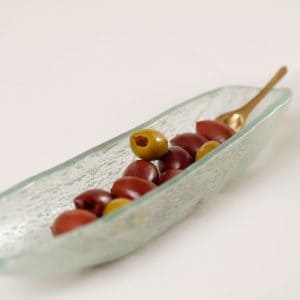
Olive Bowl for Bar Snacks and Hotel Lounge Service
The format question is the one most venues skip until a guest asks it out loud. Where do the pits go? A plain dish with no pit section pushes the guest to improvise. The improvising is what looks careless: a folded napkin, the edge of a saucer, the table itself. An olive serving dish with a built-in pit well closes that gap before it opens. The main section holds the olives. The pit bowl sits alongside, so the two-part piece reads as one considered object rather than a workaround.
MyGlassStudio builds the pit section into the olive bowl as standard, not as an upsell. That matters for a bar manager speccing a full lounge. The alternative is a second small dish per table and twice the clearing. One piece means the server drops it once and collects it once. The olive dish with pit bowl also photographs well for a brand shoot. Design teams choose it for the spaces guests post about. The cream olive bowl in warm-toned glass catches the light from a bar back. No glare creeps into the frame.
Choosing the olive dish with pit bowl format
There is also the matter of where the bowl sits among its siblings. Most lounges do not run olives alone. The same collection covers nut bowls for warm almonds and dip dishes for the small bite appetizers that come later, all cut from the same designer glass in the same custom finish range as the rest of the snacks serveware range. A table dressed from one family looks deliberate. A table assembled from three suppliers looks assembled, and guests register the difference even when they cannot name it.
Bespoke specification is where glass pulls ahead of porcelain or ceramic for this piece. Because the colour lives in the material, a hotel group can lock a single house tone. It repeats across every bar without the batch-to-batch drift that glazed alternatives bring. The studio handles the matching, moulding, and finish in-house. A modern restaurant ordering a custom olive bowl gets a piece built to its palette rather than chosen from a shelf of near-misses.
Olive Dish with Pit Bowl for Cocktail Bars and Fine Dining
Depth is the detail that separates a real olive bowl from a repurposed ramekin. Too shallow and the olives roll; too deep and the guest is fishing. The olive serving dish formats run from a compact single-portion bowl to a wider sharing piece for a table of four or more. A lounge can carry one shape for the bar rail and another for seated service. A modern bar that leans on small plate recipes benefits from the larger format. Olives rarely travel alone once the kitchen sends out nibbling boards, the kind of spread covered in the bar food presentation ideas from Excelsior Gallia.
Custom printing and the olive boat serving dish
Custom printing is available for properties that want the piece to carry their bespoke branding rather than simply sit on the table. A printed crest holds cleanly through daily service and the glasswasher, with a flush, snag-free surface that never lifts at the rim. No print wears off at the edges. For a hotel group rolling a single look across several bars, that consistency is the point, and the full lineup sits in the Buffet, Catering and Bar Lounge Catalogue. The olive boat serving dish has a longer narrow profile, an echo of the wider boat shaped bowls range. It suits a rail where space runs lengthways rather than square, and it sits beside a row of stemware without crowding the pour station.
None of this works if the glass cannot take the handling, so durability is built in rather than promised. The pieces stack without chipping at the rim, hold their clarity through repeated wash cycles, and do not craze where hot meets cold. A luxury cocktail bar can run the same olive dish for years and keep it looking like the day it arrived. That is the quiet case for bespoke glass over generic stock. It carries the brand, it survives the service, and it earns its place on a table guests watch the whole time they are in the room.
FAQ
How deep should an olive bowl be for bar service?
Deep enough that olives sit two or three layers without rolling out, shallow enough that a guest reaches the last one easily. Our single-portion bowl runs around five centimetres deep, while the wider sharing formats stay shallower for easier access.
Does the olive dish with pit bowl come as one piece or two?
One piece with two sections. The olives sit in the main well and the pits go in the smaller bowl alongside, so the server sets down and clears a single object instead of juggling a separate pit plate.
What sizes are available across the range?
The range covers a compact single-portion bowl, a wider sharing format for tables of four or more, and a longer boat profile for narrow rails. Most lounges carry two: one for the rail, one for seated service.
Is the piece suitable for a busy lobby lounge rather than a quiet bar?
Especially so. The olive bowl stacks without chipping, survives repeated wash cycles, and keeps its clarity under heavy handling, exactly what a high-traffic lobby lounge demands.
Can the olive serving dish be matched to our bar’s interior colour?
Yes. Colour is fused into the glass rather than coated on, so we match the piece to a defined palette and it holds through service. Send a reference and we work from it.
Is custom printing available for hotel branding?
Yes. We print a crest or wordmark onto the glass, fused into the surface so it holds through daily handling and the glasswasher with nothing to wear away. It suits a group rolling one consistent look across several bars.
How does glass hold up against olive oil and brine over time?
The surface is non-porous, so neither brine nor oil soaks in and nothing stains or holds an odour. A quick wipe between rounds keeps it clear, and a full wash resets it entirely.
What is the lead time for a bespoke order?
It depends on finish and volume. A standard colour moves faster than a custom match with printing. Share the quantity and spec and we give you a firm date before you commit.
Can we order matching snacks pieces alongside?
Yes, and most lounges do. The nut bowls and dip dishes come from the same collection in the same finish range, so the bar table reads as one set rather than a mix of suppliers.