

Why the In-Room Tray Deserves Strategic Attention
The guest experience begins long before the first meal is served. It starts the moment a guest enters the room and sees the welcome presentation waiting on the desk, the console, or the coffee table. In this quiet, unspoken moment, the marble serving tray performs a role far greater than its surface area suggests. Firstly, it frames the amenity. Furthermore, it signals the standard of the property. Above all, it sets the tone for every interaction that follows.
For designer hotel brands operating at the upper-upscale and luxury tiers, the tray is no longer an afterthought. Instead, it has become a deliberate component of the in-room product. Hotel teams now choose it with the same intentionality as the bedding, the lighting scheme, and the bathroom fittings.
Consequently, a considered tray, for properties who browse the Accent Trays collection, elevates the bottle of welcome wine, the fruit selection, and the turndown sweet. By contrast, a generic tray flattens them.
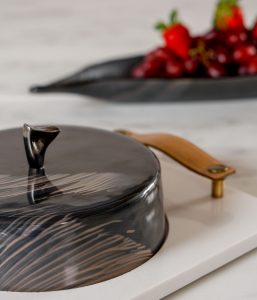
A marble serving tray anchoring a welcome presentation in a modern suite.
The Material Combination: Marble & Glass
Natural marble has long been associated with permanence and prestige, carrying both visual and physical weight. When paired with high-temperature fused glass that captures the veining, tonal variation, and depth of natural stone, the result is a sophisticated balance of strength and refinement. For designer hotel operators, this material combination offers a compelling alternative that delivers the elegance of marble with the versatility and contemporary appeal of glass.
Unlike porcelain, fused glass retains a translucency and luminosity that stone cannot match. Similarly, compared with ceramic serveware, it resists staining and thermal shock at levels suited to continuous hotel service. The outcome is a marble accent tray with a glass dome that also reads as stone to the guest.
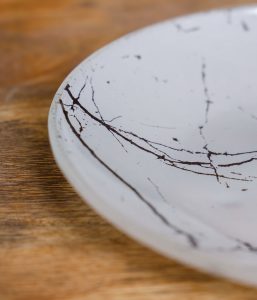
Fused glass reproduces the veining and depth of natural marble.
Where the Tray Shapes the Guest Journey
A well-chosen tray appears at multiple touchpoints across the stay. In addition, each moment is a small act of brand storytelling. Above all, every touchpoint reinforces property positioning through room food amenities that feel considered rather than generic.
Firstly, arrival presentation is the first encounter. A tray carrying bottled water, chocolates, or a seasonal fruit selection, part of a well-specified Hotel Welcome Amenities collection, communicates hospitality before the guest unpacks. Next, in-room dining follows. Trays holding breakfast covers, afternoon snacks, or late-night service cross the guest room threshold multiple times per stay.
Then, turndown service introduces a smaller, more intimate format: a confectionery, a nightcap, a handwritten card. Finally, minibar and refreshment presentations keep the tray visible between active service moments. As a result, the piece works as a quiet element of styling on the desk or console.
For properties operating at the luxury tier, the marble serving tray with handles adds a functional advantage. Notably, it enables easier transport for housekeeping and steadier carriage for in-room dining staff. Furthermore, it offers a design detail that reads as considered rather than purely decorative.
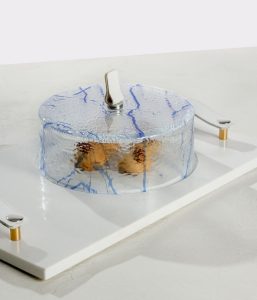
Marble serving tray with handles and a fused glass cover with marbled design by MyGlassStudio.
Design Considerations for Hotel Specification
When specifying trays across a modern hotel operation, whether reviewing the full Hotel Room Amenities & Décor collection or commissioning bespoke pieces, three factors typically govern the decision. Firstly, visual coherence with the interior design. Secondly, durability under continuous use. Thirdly, alignment with brand positioning. Each deserves deliberate attention.
Visual coherence begins with the marble itself. For example, a cool, grey-veined Carrara reference suits minimalist and contemporary interiors. Similarly, a warmer Calacatta palette with gold veining integrates naturally into richer material schemes. By contrast, darker stones. Emperador or Nero Marquina references, carry weight in bar environments and executive lounges. Therefore, the tray should speak to the room it serves, not stand apart from it.
Durability is where material choice reveals itself. In practice, hotel trays face impact from service carts, stacking and daily handling by rotating staff. A marble serving tray engineered for hospitality use resists chipping.
Brand alignment is the final layer. For instance, a boutique property might commission a bespoke shape or edge detail. On the other hand, a global brand operating under strict identity guidelines may specify a logo fused into the glass itself. This creates a permanent mark that will not wear, peel, or fade. In this sense, the designer tray becomes a carrier of the brand as much as a carrier of the amenity.
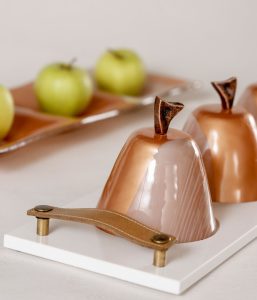
Turndown presentation using a marble-finish tray in a luxury hotel.
Operational Integration: What F&B and Housekeeping Teams Need
Specification is only the beginning. After that, trays must integrate with the operational reality of the property. This includes the pantry shelves where they are stored, the trolleys that carry them, and the staff handling them across shifts.
Stackability matters. A tray that does not nest efficiently consumes valuable pantry space. Secondly, weight matters. Ideally, a tray feels substantial yet remains light enough for repeated handling across a shift. Thirdly, edge profile matters. Notably, a rounded, chip-resistant edge reduces breakage rates dramatically over a twelve-month cycle.
For procurement teams, the calculation becomes clearer with marble and fused glass. Both materials offer exceptional long-term durability, allowing hotels to maintain a refined presentation without the frequent replacement cycles associated with less resilient surfaces. This longevity not only reduces operational costs but also supports a more consistent and elevated guest experience over the years.
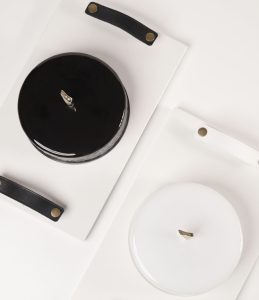
Trays prepared in the hotel pantry for in-room service.
A Quiet Signature of the Property
For leading hospitality groups, from Four Seasons to Rosewood, the small objects within the room carry the same weight as the architectural statements. In this context, a modern marble-finish tray, specified with intention, becomes part of that quiet language of standards.
The investment pays back across every guest stay. Firstly, a tray that looks considered elevates a simple amenity into a gesture. Secondly, a tray that lasts reduces operational friction year after year. Finally, a tray produced in marble offers the visual authority of stone. Ultimately, it represents the kind of specification decision that defines properties built for the long view. To explore the full range, view the Room Amenities Catalogue and our Limestone Collection.
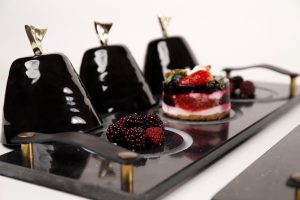
The tray as a quiet signature of the property.
FAQ
Is a marble tray suitable for daily hotel service?
Yes. Marble trays are engineered to withstand the impact cycles of continuous in-room and F&B service.
Can the tray be customised with a hotel logo?
Yes. Logos, monograms, and collection-specific markings can be fused directly into the glass dome of the marble accent tray, creating a permanent finish that will not peel, fade, or wear over time.
What sizes and shapes are available?
Bespoke sizes are standard for hotel projects. Rectangular, oval, and rounded formats are produced to specification, with handle options available for in-room dining applications and room food amenities.